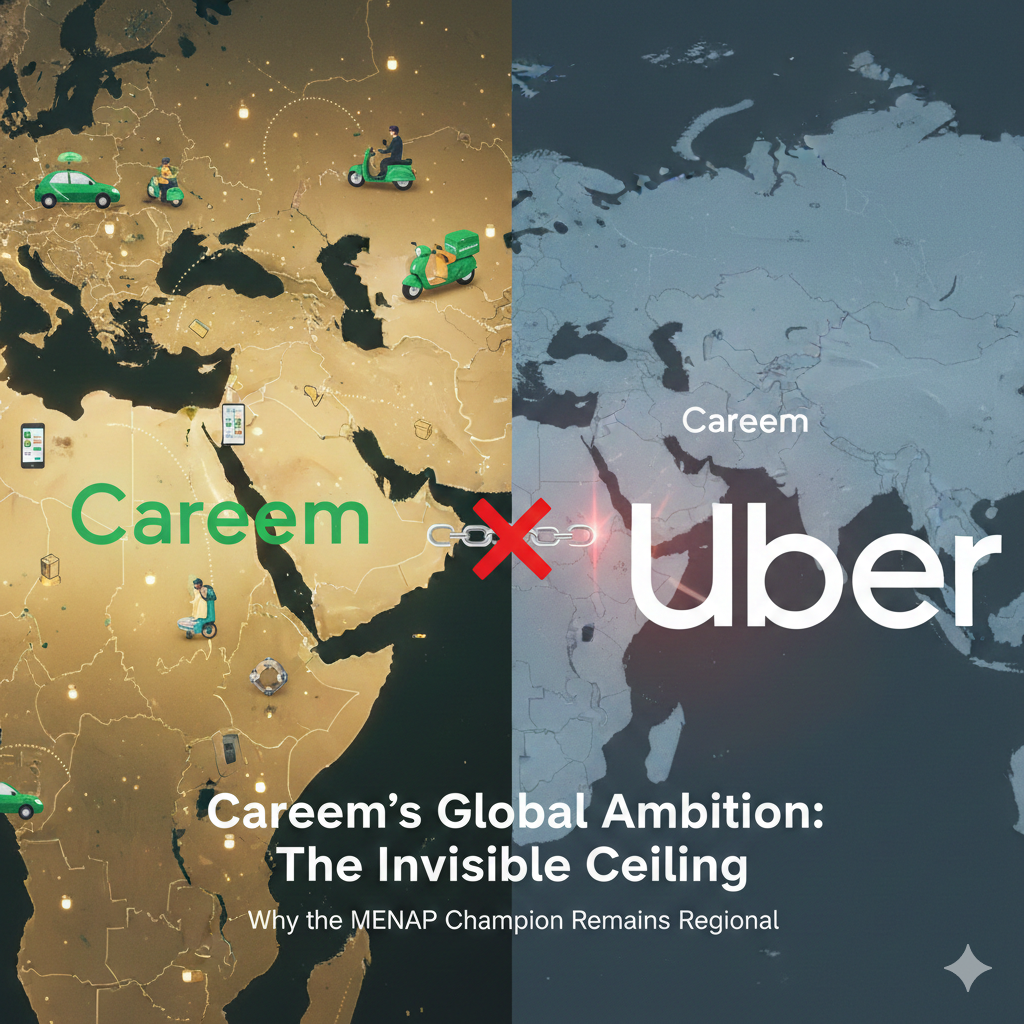
Careem's Global Expansion Challenges Post-Uber Acquisition
Despite its $3.1 billion acquisition by Uber, Careem has remained a regional champion rather than a global player due to a strategic division of territories that prevents it from competing with its parent company in markets like India or Europe. This geographic confinement was further solidified by a 2023 corporate split, which divided the business between Uber and the UAE’s e&, creating a complex ownership structure where stakeholders prioritize regional dominance over risky international expansion. Instead of pursuing geographic breadth, Careem has adopted a "vertical growth" strategy, evolving into a Super App that deepens its hold on the MENAP region through fintech, delivery, and home services. By leveraging its hyper-local expertise and avoiding expensive "subsidy wars" against established global rivals, Careem has effectively traded the goal of global reach for the security of being an untouchable regional ecosystem.
Introduction
After Uber acquired Careem for $3.1 billion in 2019, many expected Careem to expand globally under Uber's umbrella. However, the reality has been quite different. Careem remains largely confined to the Middle East, North Africa, and Pakistan (MENAP) region, while Uber dominates in markets like India, Southeast Asia, and Latin America. This article explores why Careem hasn't expanded globally and the challenges preventing this expansion.
The Acquisition Structure: A Double-Edged Sword
1 How the Deal Was Structured

When Uber acquired Careem in January 2020, the deal included a crucial provision: Careem would become a wholly-owned subsidiary of Uber, operating as an independent company under the Careem brand and led by Careem's founders. While this preserved Careem's regional identity, it also created strategic limitations.
2 The 2023 Split: Rides vs Super App

In December 2023, the business was further divided when e&, the UAE telco giant, bought a 50.03% stake in Careem Technologies for $400 million:
- Careem Rides: Fully owned by Uber, focused solely on ride-hailing with 260 employees.
- Careem Technologies (Super App): Owned by e&, Uber, and Careem's co-founders, operating food delivery, fintech, and other services with 1,400 employees.
This split means Careem is no longer a unified company that can easily expand as one entity into new markets.
Major Challenges Preventing Global Expansion
1. Strategic Market Division with Uber
The Core Challenge: Uber and Careem now operate in clearly defined territories to avoid internal competition.
Geographic Boundaries:
- Careem's Territory: Middle East, North Africa, Pakistan (MENAP region - 10 countries, 70+ cities)
- Uber's Territory: India, Southeast Asia, Latin America, Europe, North America, Australia
Why This Matters:
- Uber won't allow Careem to compete in markets where Uber already operates
- Careem entering India would mean competing against its own parent company
- This creates an artificial ceiling on Careem's expansion potential
The India Example: Before the acquisition, Careem had acquired Commut (a Hyderabad-based bus service) in 2018, signaling intentions to enter India. However, this expansion never materialized after Uber took over, as Uber already operates in India and wouldn't benefit from internal competition.
2. Ownership Structure Complications
Multiple Stakeholders with Different Interests:
For Careem Rides:
- 100% owned by Uber
- Uber wants Careem focused on MENAP, not competing globally
- Expansion decisions must align with Uber's global strategy
For Careem Technologies (Super App):
- 50.03% owned by e& (UAE telecom company)
- Significant stakes by Uber and Careem founders
- e& is primarily interested in regional dominance, not global expansion
- Conflicting priorities between stakeholders
The Challenge: Getting all stakeholders to agree on expensive global expansion when they have different strategic interests is nearly impossible. e& wants regional strength, Uber wants no internal competition, and founders want growth but lack full control.
3. Brand Identity vs Market Reality
Regional Brand Positioning: Careem built its entire brand identity around being "built in the region, for the region." The brand emphasizes trust, regional pride, and reliability, positioning as "built for the region, by the region".
The Challenge:
- This regional identity is both Careem's strength and limitation
- Expanding to Latin America or Southeast Asia would dilute the "Middle Eastern champion" brand
- Customers in new markets wouldn't have the same cultural connection
- The localization approach that made Careem successful in MENAP would need to be completely rebuilt for each new region
Cost-Benefit Question: Why would Uber invest in building Careem's brand in new markets when it already has Uber there?
4. Resource Allocation and Investment Priorities
Current Focus: Careem is focused on deepening services in existing markets rather than expanding geographically.
2024-2025 Priorities:
- Expanding super app services in current cities
- Careem Food expanded from Dubai, Riyadh and Amman to also serve Abu Dhabi
- Careem Pay expanded its international remittance service to 35+ countries (for money transfers, not operations)
- Launching new services like electronics delivery, cleaning services, and Careem for Business
Why This Approach:
- Deepening existing markets is less risky and expensive
- The super app model creates stronger competitive moats
- Higher profitability from established markets versus risky new market entry
- Better return on investment for stakeholders
5. Regulatory and Compliance Complexity
The Challenge: Operating globally means navigating different regulatory frameworks in each country.
Specific Issues:
- India has strict regulations for foreign-owned tech companies
- Data localization requirements vary by country
- Labor laws differ significantly across regions
- Payment regulations and fintech licenses are country-specific
Careem's Current Advantage: Careem's long-standing relationships with regional authorities and policymakers help navigate complex regulatory landscapes in MENAP. This advantage doesn't transfer to new markets.
Why It Prevents Expansion: Building regulatory relationships and obtaining licenses in 50+ new countries would take years and massive investment, with uncertain returns.
6. Competition from Established Local Players
The Reality: Most lucrative markets already have dominant players.
Market by Market:
- India: Uber, Ola, and now Rapido dominate; market is extremely competitive
- Southeast Asia: Grab and Gojek have super app models similar to Careem but with deeper local penetration
- Latin America: Didi, Uber, and local players like Cabify have established presence
- Europe: Uber, Bolt, and FreeNow control major markets
- Africa: Bolt, Uber, and local players like Yango operate across the continent
The Challenge: Careem would be entering as a latecomer in markets where competitors have:
- Established driver and customer networks
- Local regulatory approvals
- Brand recognition
- Optimized operations
Network Effects Problem: Ride-hailing has strong network effects (more riders attract more drivers and vice versa). Breaking into established markets requires massive subsidies to overcome these effects, which shareholders may not support.
7. Technology and Operational Complexity
Super App Integration Challenges:
- Careem's technology stack is optimized for MENAP markets
- The platform's tech stack includes cloud computing for real-time data management, machine learning for personalized user experiences, and blockchain for secure payments
- Adapting this to completely different market conditions is expensive
Specific Technical Hurdles:
- Payment systems would need complete overhaul for each market
- Local language support beyond Arabic/Urdu/English
- Integration with local banking systems
- Different mapping and GPS systems
- Varied internet infrastructure quality
Operational Differences:
- MENAP markets have unique characteristics (cash preference, cultural norms)
- New markets would require different operational playbooks
- Driver training and management systems would need adaptation
- Customer service approaches vary by culture
8. Financial Viability and Profitability Concerns
Capital Intensive Nature: Global expansion would require:
- Billions of dollars in subsidies to attract drivers and riders
- Marketing spend to build brand awareness
- Technology infrastructure investments
- Regulatory compliance costs
- Local team building and office setup
The Profitability Challenge: Ride-hailing companies struggle with profitability globally. Even Uber took years to achieve profitability. Careem stakeholders, having already built profitable operations in MENAP, are reluctant to sacrifice current profits for uncertain future gains.
Uber's Perspective: After spending billions trying to win markets globally, Uber learned that competition is expensive. Why would they encourage Careem to repeat expensive expansion mistakes when Uber already serves those markets?
9. Cultural and Organizational Challenges
The Cultural Identity Issue:
- Careem's company culture is deeply rooted in Middle Eastern values
- The organization is built around understanding and serving the MENAP region
- Careem developed a unique operational style that catered to MENAP consumers, whereas Uber operated on a more standardized global framework
Talent and Expertise Gap:
- Careem's team has deep MENAP expertise but limited knowledge of other markets
- Hiring and training teams for new regions is time-consuming
- Cultural differences in management styles
- Language barriers beyond Arabic and English
Organizational Challenges:
- Maintaining company culture while expanding globally
- Decision-making complexity with multiple stakeholders
- Resource allocation conflicts between regions
- Brand consistency versus local adaptation
10. The Uber Cannibalization Problem
The Fundamental Conflict: This is perhaps the biggest challenge.
Uber's Dilemma:
- If Careem expands globally and succeeds, it might take market share from Uber
- If Careem fails in new markets, it's wasted investment
- Either way, Uber (the majority stakeholder) doesn't benefit from Careem competing with itself
Why Uber Blocks Expansion:
- Uber already has strong brands (Uber, Uber Eats) in most markets
- Building Careem's brand in these markets would cannibalize Uber's business
- It's more efficient to strengthen Uber's position than create internal competition
- Shareholders would question why Uber is funding a competitor to itself
The Strategic Lock-In: Uber's ownership essentially locks Careem into the MENAP region, making global expansion strategically irrational from Uber's perspective.
What Careem Is Doing Instead: Regional Domination
The Super App Strategy
Rather than expanding geographically, Careem is expanding vertically within its existing markets:
Current Services:
- Ride-hailing: Core business with over 90 million trips in 2024
- Food Delivery: Careem Food, growing rapidly with exclusive partnerships
- Grocery Delivery: Careem Quik with ultra-fast delivery (some in under 2 minutes)
- Fintech: Careem Pay with remittances to 35+ countries
- Bike Sharing: Careem Bike in major cities
- Bus Services: Mass transit solutions
- Package Delivery: Careem Box
- Home Services: Cleaning, laundry, and maintenance
- Dining Discounts: Careem DineOut
- Electronics Delivery: Careem Quik Electronics
- Business Services: Careem for Business
- Subscription: Careem Plus membership program
Market Penetration Success
Careem holds over 60% market share in several MENA territories, including the UAE, Saudi Arabia, and Pakistan, demonstrating that regional dominance is working.
Growth Metrics:
- Since its shift to a super app in 2020, Careem has seen its user base grow by an astonishing 900%
- By 2024, the platform boasted over 48 million registered users, offering 12 distinct services
- Revenue exceeded $500 million in 2023
The Remittance Expansion: A Strategic Alternative
Not Geographic Expansion, But Service Expansion
Careem Pay expanded to the UK, Ireland, France, Spain, Germany and Italy for remittances, but this doesn't mean Careem operates ride-hailing or delivery there.
What This Means:
- Users can send money TO these countries FROM the MENAP region
- Careem isn't providing ride-hailing services in these countries
- It's a lower-risk way to have a "global presence" without full operations
Strategic Benefits:
- Serves the large expat worker population in MENAP who send money home
- Lower regulatory burden than operating transportation
- Doesn't compete with Uber
- Creates fintech revenue without geographic expansion
Lessons and Implications
For Careem
The Acceptance: Careem seems to have accepted its role as the MENAP regional champion rather than a global player.
The Opportunity: The MENAP region has 400+ million people across 10 countries with growing digital adoption. Dominating this region completely might be more valuable than spreading thin globally.
The Reality: Careem doesn't aim to compete head-to-head with Uber globally; instead, it dominates where it understands best — MENA, South Asia.
For Uber
Strategic Success: By acquiring Careem, Uber eliminated its biggest regional competitor while preserving value through Careem's continued MENAP operations.
Best of Both Worlds: Uber benefits from Careem's MENAP profits without internal competition in other markets.
For Entrepreneurs
The Cautionary Tale: Being acquired by a larger competitor can limit your growth ambitions, even if it comes with a massive payout.
The Trade-Off: Careem's founders got $3.1 billion but lost the ability to build a truly global company.
Regional Champions Can Work: You don't need to be global to be valuable. Deep regional dominance can be more profitable than thin global presence.
Future Scenarios
Scenario 1: Continued Regional Focus
Most likely scenario. Careem continues deepening its super app in MENAP, adding more services and entering smaller cities within the region.
Scenario 2: Adjacent Market Expansion
Possibly expanding into nearby markets not strongly served by Uber, such as some African countries or Central Asian nations.
Scenario 3: Strategic Pivot
If ownership structure changes again, new stakeholders might push for expansion, though this seems unlikely given current success.
Scenario 4: Complete Integration
In the distant future, Uber might fully integrate Careem into Uber's global operations, ending Careem as a separate brand. However, the 2023 split of the super app business makes this less likely.
Conclusion
Careem's lack of global expansion isn't due to lack of capability or ambition—it's a strategic consequence of the Uber acquisition and subsequent ownership structure. The combination of Uber wanting to avoid internal competition, multiple stakeholders with different interests, the success of regional focus, and the practical challenges of entering established markets have created a situation where global expansion makes little strategic or financial sense.
Rather than seeing this as a failure, it might be more accurate to view it as a strategic choice: Careem is choosing to be the dominant super app in the MENAP region rather than a struggling challenger in global markets. Given that the MENAP region represents a massive, growing market with 400+ million people and increasing digital adoption, this might actually be the smarter long-term strategy.
The key takeaway for entrepreneurs and business observers is that acquisition by a larger competitor, while potentially lucrative, fundamentally changes your strategic options. Careem traded global expansion potential for regional dominance and a $3.1 billion exit—a trade-off that seems to be working, even if it means never entering markets like India or Southeast Asia.